

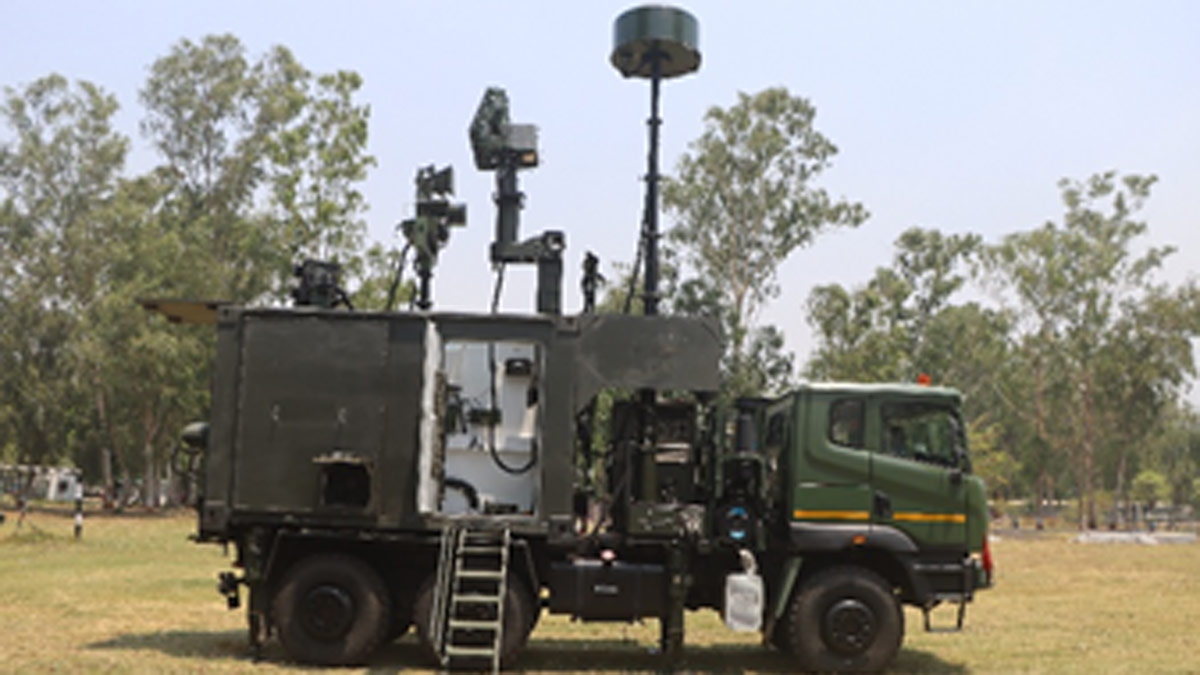
High-Stakes Operational Precision During Operation Sindoor
From June 6 to July 10, Indian military units maintained relentless vigilance, with personnel on high alert during a critical operation that involved swift detection and neutralization of aerial threats. According to Wing Commander Dakshesh Chauhan, there was hardly a moment of rest, reflecting the intensity of the deployment.
The operation’s success was underscored by the deployment of India's advanced air defense network, which integrated satellite imagery and radar systems to monitor the entire airspace from the Andaman Islands to Kashmir and from Kutch to the northeastern states.
Chauhan emphasized that within 90 minutes, India conducted a comprehensive air operation that effectively subdued Pakistani drone and missile threats, showcasing the capabilities of their indigenous systems. He explained that the operation involved using the full spectrum of air defense assets, including missile systems designed for rapid response.
‘In 90 minutes, we brought Pakistan to its knees,’ Chauhan asserted, highlighting the operational efficiency achieved through the S-400 missile system.
Technological Edge: The Strength of India’s Autonomous Air Defense System
India’s air defense network is described as one of the most comprehensive globally, with a fully indigenous, automated system that continuously monitors the entire airspace. Chauhan detailed that the integrated radar network spans the country and feeds data into the Indian Air Command and Control System (I-ACCS), allowing near-instantaneous identification and response to any airborne object.
The system’s automation means missiles are tracked and launched automatically, with manual intervention possible if required. This advanced automation enables detection of aircraft or drones within two minutes of their takeoff, even if they are approaching from neighboring countries or within complex boundary zones.
The network’s capability to identify civil and military aircraft simultaneously enhances situational awareness, with civil flights and potential threats monitored in real time. Chauhan explained that the entire surveillance infrastructure is active 24/7, tracking approximately 8,000 civil flights across India’s airports and airspace.
‘Our indigenous system is better than Israel’s,’ Chauhan claimed, emphasizing the system’s automation and integration advantages.
Detection and Neutralization of Threats: A Coordinated Response
Chauhan described how the integrated radar network detects aircraft from hundreds of kilometers away, with the ability to identify and classify objects within minutes. Once a threat is detected within Indian airspace, the system automatically alerts military units, which can respond swiftly to neutralize the threat.
He detailed that if a Pakistani drone or aircraft approaches the designated boundary, the system identifies it before it enters the core airspace. The process involves cross-referencing civil and military radar data, with the potential to engage targets proactively based on predefined protocols.
The operation demonstrated that even with a barrage of 200 to 300 drones launched simultaneously by Pakistan, most were unable to hit their intended targets, thanks to the layered, automated defenses.
‘Within two minutes, we identify and respond,’ Chauhan explained, illustrating the rapid reaction capabilities of India’s air defense network.
Strategic Significance and Global Context of Indigenous Defense Systems
Chauhan highlighted that India’s air defense architecture is largely indigenous, built on domestic technology, and fully automated. The entire network spans from the Andaman Sea to the borders with Pakistan and China, offering comprehensive coverage that surpasses many international systems.
He noted that the entire surveillance and command system is integrated, allowing command units across the country to access the same real-time data, facilitating coordinated responses regardless of geographic location. This integration is vital for maintaining operational security and rapid decision-making during crises.
The deployment of the S-400 missile system during the operation exemplifies India’s strategic shift towards autonomous, high-precision defense capabilities. Chauhan pointed out that such systems have significantly enhanced India’s ability to defend its airspace without reliance on external support, marking a notable evolution in regional military dynamics.
‘Our system is one of the best in the world, better than Israel’s,’ Chauhan stated, emphasizing the indigenous development and automation of India’s air defense network.
Looking Ahead: The Future of India’s Air Defense Capabilities
The detailed account of Operation Sindoor underscores India’s strategic focus on rapid, autonomous defense systems capable of countering complex threats. With continuous upgrades and indigenous technological advancements, India aims to maintain a robust shield over its airspace amid regional tensions.
Chauhan’s insights suggest that India’s integrated, automated radar and missile systems are designed not only for current threats but also to adapt to evolving aerial warfare scenarios, including drone swarms and stealth aircraft.
The operation’s success raises questions about future adversary strategies and India’s preparedness to counter increasingly sophisticated threats, emphasizing that technological sovereignty remains a cornerstone of national security planning.
‘Our capabilities will only improve,’ Chauhan concluded, hinting at ongoing developments in India’s autonomous air defense infrastructure.